
Friday evening in Shenzhen, in the heart of Futian District. I am standing in the vast square of the Civic Center, rooted to the spot. I thought I was prepared for the technological shock, yet the sight caught me completely by surprise.
Around me, the façades of 43 skyscrapers form a single, gigantic, continuous digital canvas. This is not projection: LED mesh screens, invisible by day and integrated into the buildings' glass walls, light up together with millions of individually controlled points of light.1, 2 The music—a majestic symphonic composition, now slow, now dynamic—fills the square, while the lights follow its rhythm with millisecond precision.
The fifteen-minute performance tells the city's story in four acts. In the first, “The City of Mountains and Sea,” landscapes recalling classical Chinese painting, rolling waters and mountain peaks drift across the glass giants. Then the pace quickens. “The Window of Reform” brings up the famous statue of the “Pioneer Ox” and the stock exchange building, symbols of “Shenzhen speed.” The third act, “Capital of Innovation,” is pure cyberpunk: data streams, DNA spirals and futuristic vehicles race between the buildings. Finally, “The Realm of Harmony” closes the sequence, with mangrove forests and flocks of birds flying across the towers as warm colours flood the city.3, 4, 5
Standing in the crowd—quietly but precisely guided and monitored by the artificial intelligence of the “City Brain”6—I realised that this was not merely a tourist attraction. It was a demonstration of power. Its message was that China can turn physical reality into a single, centrally controlled organism communicating over 5G.7
The “DeepSeek moment”
That overwhelming experience was the physical counterpart of the intellectual shock that had brought me here. On 20 January 2025, the world's technology community—and I with it—awoke to the news that a Chinese laboratory, DeepSeek, had created an AI model for a budget of only $6 million, compared with the billions spent by its American rivals, and that the model could compete with Silicon Valley's leading products.8, 9
How was this possible? How could a country regarded for decades as the home of imitation suddenly leap to the forefront of innovation? I felt that answers filtered through the Western press were not enough. I had to see it for myself. So I set out for Shenzhen, behind the Great Firewall, without a guidebook—because technology changes so quickly here that a book would already be out of date by the time it appeared.
From rice fields to a cyberpunk metropolis
Shenzhen's story is one of the most dramatic examples of modern urbanisation. In 1979, the area near the Hong Kong border had barely 30,000 inhabitants and was dotted with rice fields and fishermen's huts.10 Today, little more than four decades later, a metropolis of nearly 18 million people and a GDP of $480 billion stands in its place.11
The pulse of the city is defined by the famous idea of “Shenzhen speed.” The phrase emerged in the 1980s during construction of the Guomao Building, where workers achieved the previously unimaginable pace of “one floor every three days.”12 Today the same speed appears in technology development. A hardware product cycle that takes 12 to 24 months in Silicon Valley can be compressed to one or two months in Shenzhen.13
Huaqiangbei and the Shanzhai ethos: from outlaw honour to innovation
The engine of this technological miracle is Huaqiangbei, the world's largest electronics market. It covers 1.45 square kilometres, where 20,000 merchants serve almost one million visitors each day.14 This is where I began to understand the secret of Chinese innovation: the culture of Shanzhai (山寨).
The term Shanzhai originally meant “mountain stronghold,” evoking the outlaw rebels of the classic novel Water Margin.15 In the 2000s, it came to signify a kind of “guerrilla innovation” directed against Western technology monopolies. The market's slogan does not lie: “Design it in the morning, manufacture it by afternoon.”16
This system is a radical form of open innovation. Designs and component lists are shared freely, making extraordinarily rapid iteration possible.17 This “combinatorial innovation” enabled global companies such as DJI, BYD and Transsion—the latter now controlling 40 per cent of Africa's mobile-phone market—to grow out of an ecosystem once known for cheap copies.18
Robots among us: embodied intelligence
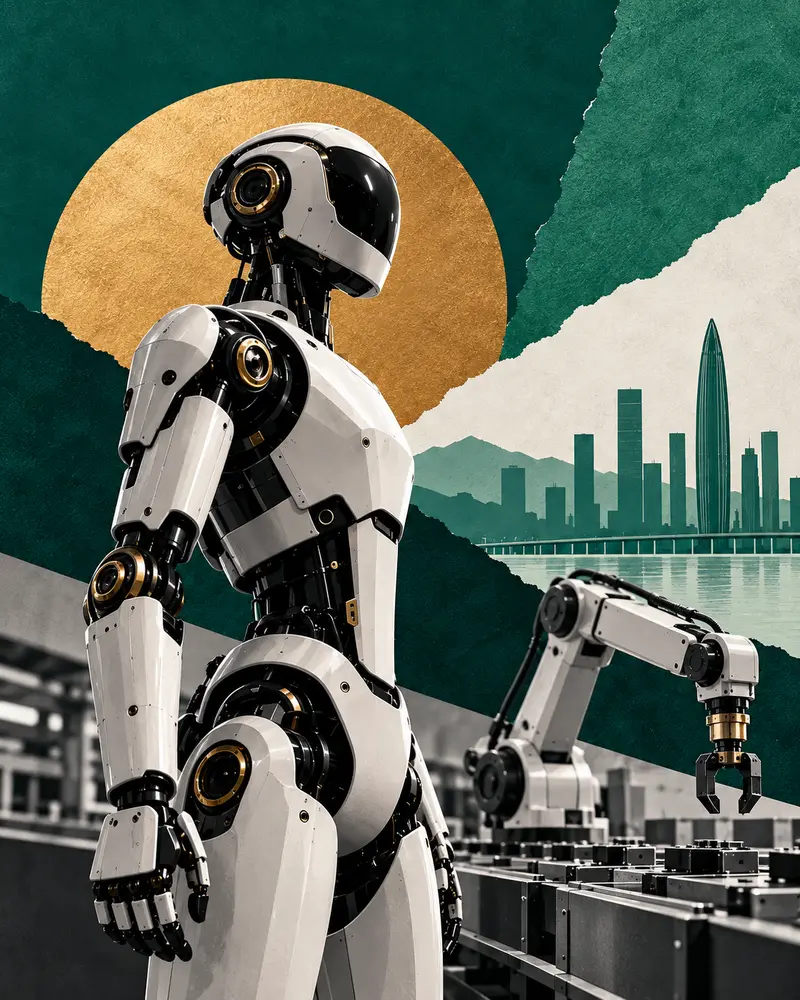
The most visible sign of technological dominance is the everyday presence of embodied AI. In China, robotics is no longer at the experimental stage; it has become an industrial and social reality.
From the hotel “butler” to the police robot. At my hotel, a Keenon Butlerbot W3 delivered the food I had ordered. The machine does not simply roll along corridors. Using built-in LiDAR and stereo cameras, it navigates independently and communicates with both the lift controls and the hotel's telephone system, calling my room when it arrives.19, 20
On the street, I met a police robot called Jing Xiaonan (PM01). Developed by Shenzhen-based EngineAI, this humanoid already uses the DeepSeek language model and can engage passers-by in dynamic conversation. Its kawaii, or cute, appearance is deliberate: the goal is to build trust rather than fear, while the robot analyses its surroundings in real time over a 5G connection.21, 22
Humanoids in industry. I also saw Unitree's G1 humanoid robot, which costs only $16,000—a fraction of the price of its Western competitors.23 These robots can already jump and run, and they are increasingly taking on work in car factories, including on BYD assembly lines, in response to China's looming demographic crisis and labour shortage.24
The five-layer cake: where does the competition stand?
Jensen Huang, CEO of Nvidia, describes the AI race as a “five-layer cake.”25 In Shenzhen, it became clear that China has already moved ahead in some of those layers.
Energy. China is the undisputed leader. Shenzhen operates one of the world's most advanced virtual power plants,26 and the city's bus fleet has been fully electric since 2017.27 In the United States, approving a new power plant can take years; here, the expansion of the grid keeps pace with AI's demand for energy.28
Chips. The United States, led by Nvidia, remains ahead at this layer, while sanctions are slowing China. Yet Huawei and SMIC are rapidly building domestic production capacity.29
Infrastructure. When it comes to the speed of building data centres—another form of “Shenzhen speed”—China is unmatched.30
Models. DeepSeek demonstrated that software optimisation can compensate for limited raw computing power, bringing the contest in this layer close to a draw.31
Applications. China leads. Technology is integrated much more deeply into society—from robots and payment systems to smart-city solutions—than it is in the West.32
The price of control and the “Kill Line”
The picture would be incomplete without discussing pervasive surveillance. Shenzhen is a model city for the “Xue Liang,” or “Sharp Eyes,” programme.33 Cameras and facial recognition are part of everyday life. Biometric identification is required to enter museums and universities, and even to use a hotel lift.34
Most striking is the state's restriction on minors' online gaming time: three hours per week, enforced through facial recognition.35 To Western eyes, this is dystopian. From a Chinese perspective, it is a guarantee of “social stability.”
According to the “Kill Line” theory circulating on Chinese social media, the United States has reached the point where freedom comes at the expense of safety—visible in deteriorating public security and drug problems—whereas the Chinese model guarantees safety at the cost of restricting freedom.36
Chinamaxxing: the West's new ideal?
The “Chinamaxxing” trend spreading on TikTok suggests that some young Westerners no longer see only dictatorship in China; they see a form of modernity that works.37 They envy the clean, punctual metro systems, the public safety and the technological convenience.
I felt this duality in Shenzhen as well. On one hand, there is the dizzying speed of technological singularity. On the other, people possess a kind of “yogic calm.”38 Elderly people practise tai chi in the parks, while thousands of young people sit on the floor reading in an 82,000-square-metre bookshop that stays open around the clock.39
Conclusion: messianism versus pragmatism
Western AI development is often permeated by a kind of “technological messianism,” in which artificial general intelligence appears as a godlike entity.40 China's approach, by contrast, is thoroughly pragmatic: AI is a “new productive force” to be put to work in factories, logistics and urban management.41
China is not building “God”; it is building a superefficient worker. Shenzhen shows that this pragmatic, hardware-centred approach—combined with the speed of Shanzhai innovation—may reshape the economic map of the twenty-first century. Like the heroes of Water Margin, Shenzhen's engineers play by their own rules, and they appear to be winning the conquest of the physical world.